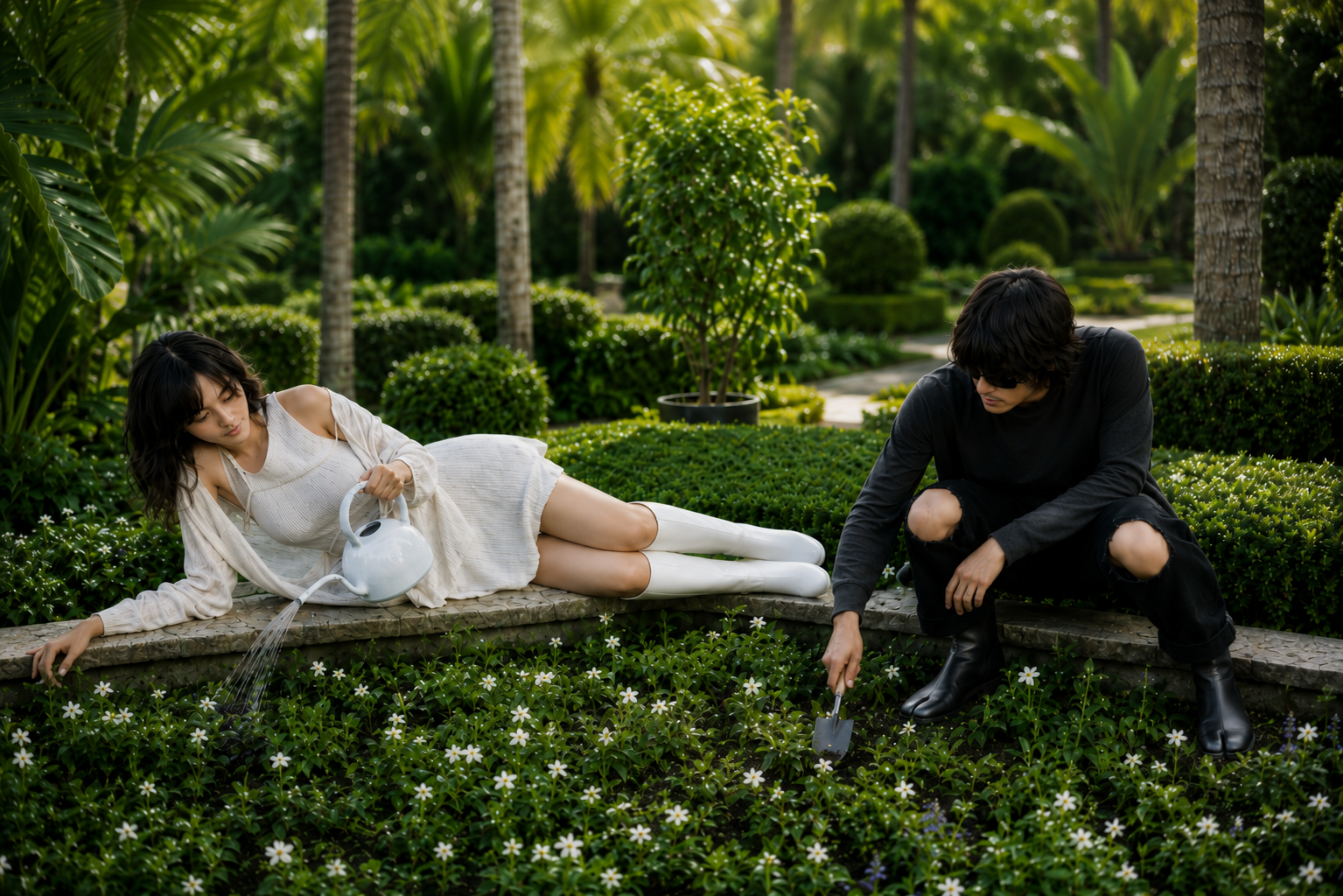
Cultivate Your Own  arden
arden
For most of history, intelligence was scarce. It lived in people and in books, handed down one generation at a time, at the speed of a human life. That is ending. Over the next few years intelligence will become abundant — cheap, capable, everywhere — and abundance on this scale reshapes everything around it. The questions that decide what kind of world these systems build are human ones: who tends this intelligence, who keeps what it produces, and whose life it serves. The technology is neutral. Everything depends on the ground we plant it in.
The farm and the dark forest
The farm feels safe, and that feeling is the design. The gates are polished, the models ready, the cursor calm, and everything you bring becomes useful at once, often for free. The promise is real, and the cost arrives quietly beneath it. A farm exists to harvest, and here the crop is you — your patterns, your instincts, the questions that reveal what you'll build next, gathered into a system you don't own and turned into someone else's advantage. The whole estate is run from one center, and that control is why it feels safe, and why everything on it drifts toward a single shape, until the safest place to grow is where nothing surprising grows at all.
So some people leave for the dark forest, where at first it feels like freedom: no gates, no center, only open repositories and weights you can hold in your own hands. The freedom is real, and so is the danger. Every door stands unguarded — a repository cloned at midnight, a package that asks for more than it needs, a skill carrying instructions you never read; by one researcher's count, more than a quarter of those shared skills hide something malicious. The forest asks you to be technical, watchful, and alone, and hands you every risk to carry. Both places end in the same bargain: trade your sovereignty for safety, or your safety for freedom — for years, the whole of the choice.
A third ground
There is a third ground, and all of it turns on something small: the structure of the fence. The forest has no fence, and so no safety. The farm has one vast fence around everyone, held by its owner, and so no sovereignty. The garden gives each person a fence of their own — a small, real boundary around their own plot, on their own Mac. It is built from the security already in the machine: the Secure Enclave, the sandbox, the trusted foundations of Apple Silicon. Computation runs on-device, and when the garden reaches the wider world it does so through protected paths, with the gardener's safety built in.
Inside that fence, learning lives with you. Your models grow beside your files, shaped by your work and your approvals; you can fine-tune small models and tend your own adapters, so your intelligence follows a path that stays with you. This is gOS — a secure enclave for personal intelligence, where the safety people sought on the farm and the freedom they sought in the forest finally share one ground: a Mac that knows your work and keeps it yours.
An ecosystem for culture
A single garden is a beginning; many tended together become an ecosystem. Almost everything we value is culture — music, code, the design of a model, research, language, taste — and culture grows the way gardens do: someone cultivates an idea worth keeping, and the rest of us build on it. Centralized AI treats intelligence as a question of scale: gather all of human experience, compress it into one enormous model, serve everyone from the same center. There is power in that, and a limit, because intelligence is the ability to adapt to a particular life, and adaptation resists being averaged. A model trained toward the center drifts toward the middle, more capable and more uniform at once, until it becomes a monoculture: efficient, impressive, and quietly fragile. Living things work the other way, beginning with variation and many separate histories, and the new emerges at the edges where one line of experience meets another. The Mac already holds what a garden needs, and files are how a machine remembers; gOS gives that memory a working mind — a local agent to act for you, Flows to capture what you repeat, a memory that grows beside your files. Each Mac becomes a living node, and Newcoin links the nodes, so a Flow that works or a small model that learned something true can travel from one garden to the next. Discoveries move freely between minds, and the minds stay their own.
Cultivate your own garden
In the end there is a simple thing you can do, the oldest thing of all: you can cultivate. A garden rewards attention, and what you tend, grows. Over time your Mac becomes a place that knows your work — your taste in its soil, your judgment in its shape, your history in its roots. Your intelligence grows from your own ground, toward your own ends, and it stays yours. Because it stays yours, it stays ours: every well-kept garden makes the whole landscape richer, more varied, more alive. The future of intelligence can be a living landscape of millions of gardens, each one personal, all flourishing together — and it begins the moment you tend your own.
Open gOS on your Mac, and cultivate your own garden.